
I have heard it said that Baltimore is shaped like a martini glass, or a capital, serifed “I,” with the center city’s Canton, Harbor East, Inner Harbor, and Federal Hill forming the bottom, connected by Charles Street and I-83 up to Roland Park, Mount Washington, Guilford, and Belvedere along the top. But all that that shorthand, intended to summarize the city’s geography for urban designers, really maps, of course, is middle-class and affluent Baltimore – the only Baltimore that before Homicide: Life on the Streets and The Wire, many people who grew up in the greater metropolitan area knew very well.
Given Baltimore’s geo-social configuration since the 1960s, for anyone living in its stable and more desirable neighborhoods, it is physically possible to get into a rhythm of life, shuttling, perhaps, between the north end of town and its commercial center using the highway every day, without ever encountering struggling communities in the East, West, South, or even some downtrodden sections of the Northeast.
While I have not always lived in Baltimore, I did partly grow up here and am grateful to have spent most of the past several years doing community development work in local neighborhoods, including one just down the street. From the cafe in which I type, it is less than a mile’s walk each to one of the most wealthy, and to one of the least wealthy, parts of Baltimore. But to visit these places, on either side of a busy thoroughfare where racially restrictive real estate policies were once implemented, is like going to two different countries. And without many commercial destinations in either community, it is sometimes hard to explain a one’s presence as an outsider. (Often, when visiting one neighborhood down the road for work, I would be stopped by residents and police officers making sure I understood the dangerousness of the place.)
It might seem safer, especially for those who have lived through trauma of some kind, to let what’s out of sight be out of mind and to stay away from people who look like people who have done terrible things. It can be tempting to go along with the construct that communities can be totally separate. At least until something like April’s riots happen. While I was not yet born when Baltimore experienced its most severe large-scale violence and unrest, what I saw on television last month helped me see how grudges against strangers can take root. The notion that a gang of young men can ransack an innocent family’s livelihood and a community’s lifeline in looting or destroying a small shop – or the fact that the odds can seem to be so stacked against an innocent inner-city baby before he is even born – without acknowledgement, repentance, and reform, appear too big and too dark to tackle head-on.
Changing perspectives
It is actually just this type of impasse that, I feel, can cause people to think differently – for comfort at first, if nothing else. Like just about anyone who has ever taken an introductory physics class probably has, I often marvel at what I’ve learned about the properties of light. Just pondering the fact that the speed of light is constant with regard to just about everything that is not also traveling at or approaching its speed is awe-inspiring. It’s as if everything even slightly dark is happening in a space that is infinitely small. And certainly small compared to the vast realm in which of each us can ponder and imagine what should or could be.
I believe that it is this, frustrated, ability to ponder what is ideal, but not evident, that leads some people to rebel directly against dissonant situations. Just as a child who has only ever known absent or abusive guardians must know intuitively that this is not real parenthood, a person who has only ever known despondency or complacency with dysfunctional social norms knows that this is not real citizenship. It can be hard to know what to do with this knowledge, the impulse to rebel against the counterfeit being so strong. Still, the answer cannot be violent insubordination.
Undeployed resources (an idea)
A few days before the recent riots, I happened to run into an acquaintance in the neighborhood of Hampden – a gritty, but slowly gentrifying part of Baltimore, full of restaurants, coffee shops and upstart art galleries. This friend, who is an artist and nonprofit founder who happens to be of European descent, was sitting on a front stoop on the main street known as The Avenue with a teenage-looking African-American young man he was mentoring, just eating ice cream together. As unremarkable as it sounds, seeing this pair, clearly from completely different backgrounds, getting to know one another in this way was notable and heartening. I believe these two also pondered what was ideal, saw it wasn’t happening, and rebelled. I have been told and have often found that when making decisions or looking for guidance, it is always best to follow a sense of quiet peace, and let that govern. I imagine it was by following this type of internal compass, which unified them, that both my friend and this young man opted to rebel constructively starting at the smallest scale.
There is a wealth of untapped resources in and around this city, and there are many other people like this pair with both a heart and a willingness to serve. Many so-called “millennials” and others, in fact, have made career decisions to devote their lives to effecting positive change in cities. But these efforts seem to have failed so far to make a big difference for the poorest neighborhoods. It is worth noting that many of these same people are often weighted down by college and graduate school debt, living at home with parents in relatively posh suburbs. Other people, who hail from the roughest neighborhoods and have left to pursue higher education seem individually reticent to return later in a phenomenon known as “Black Flight.”
Since many of the problems facing post-industrial cities like Baltimore are macroeconomic in scale, one could argue that they need to be tackled at that level. What if urban policies paved the way for a critical mass of this pent up supply of educated goodwill and empathy to reach the urban areas in greatest need? Federal Pay As You Earn plans, for example, could be expanded for all to loosen some frozen assets; and Public Service Loan Forgiveness programs could be enhanced to help, and possibly even incent, socially entrepreneurial borrowers to move nearer areas with great need and potential, helping to lift up stagnant and emptying neighborhoods.
Such an education loan-based initiative could be one potential opt-in use of Justice Department Criminal Justice Innovation Grant funds, especially if Federal Promise Zone designations could be broadened. One could argue that, as an investment, such an approach could present more potential benefit to communities than either casinos or regional trash incineration projects – both popular topics for discussion in Baltimore recently, considered by many to mean little more to the city than proverbial red porridge in the long run.
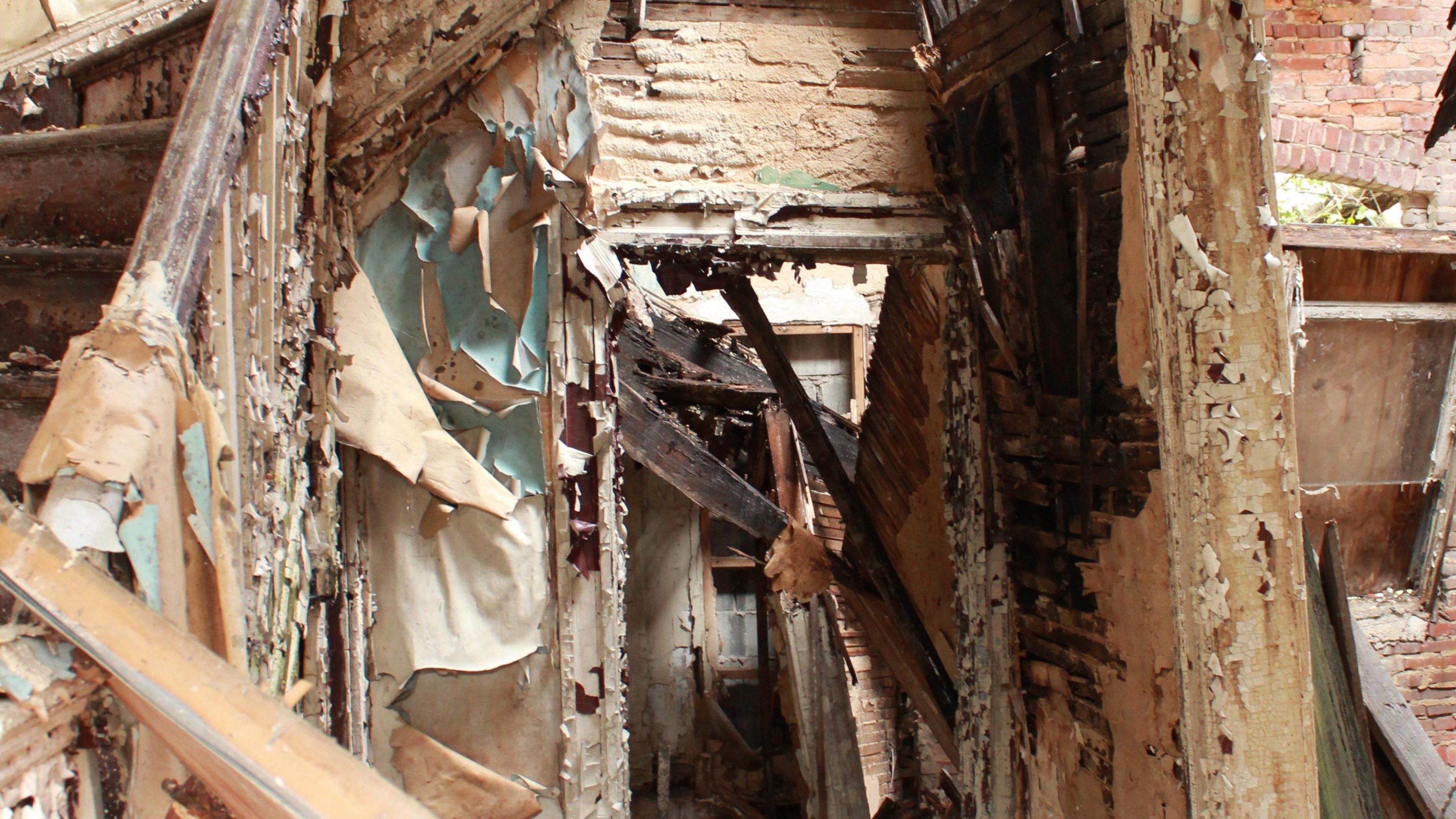
According to the Baltimore Neighborhood Indicators Alliance, a community’s downward spiral can be predicted with great accuracy once its vacancy rate exceeds just 4%, and many neighborhoods have exceeded this threshold. Just as this tiny fraction can have a major impact on a neighborhood, a struggling community can have a major effect on its surrounding area, region, and so forth. It is clear that something needs to change.
Embedded advocates
On Thursday, addressing the American Institute of Architects in Atlanta, a former American president noted that, today, at the largest scale, “borders look more like nets than walls.” I believe this type of border porosity – for willing talent – is arguably possible within and between cities like Baltimore and could prove a key weapon against urban decay.
For all of the outward advocacy struggling Baltimore communities receive, it is the neighborhoods with invested resident advocates who have, in the past, been exposed to more successful models, that usually seem to fare best. It is instructive that, in one large swath of Southwest Baltimore where many young people took up residence before the housing crash of 2008 made selling their homes when starting families temporarily impractical, a formidable coalition of neighborhoods, real estate developers, educators, and designers has organized for the purpose of improving life in the area. This cooperative of new residents, seeing a downtrodden community with fresh eyes, has started to behave almost like a type of net – actively working to identify and make use of underappreciated good.
Grassroots, resident-driven projects can help transform neighborhoods, their cultural institutions, and lovingly stewarded public spaces into destinations – rather than simply host sites for the legal and illegal drug transactions so many people travel to Baltimore to conduct. There is a complementarity between the configuration of the built environment and the interactions it hosts, and social and spatial problems can be approached in concert.
The greatest city
In Baltimore, city park benches are famously blazoned with the phrase “The Greatest City in America.” Since the world is experienced individually, this certainly may and can be the case for many people. It is worth considering that, as people are free to move where their skills are most needed and appreciated at any given time, the best city can conceivably be all cities. As educated social entrepreneurs who want to live in cities are welcomed and enabled to follow their hearts there, their interactions with one another and existing residents may help unleash creative energy that could help set the stage for communities that are more sustainable in practically every sense of the word. The world, and its larger-scale social and environmental problems, of course, is not waiting around.
I believe that, in all of our cities, “I” can actually be the answer – depending on how this idea is defined. Past and even present conditions don’t always necessarily have to define us. What if, as we yield to that internal compass of peace, and help free others to do the same, we can, collectively, redefine cities? This is real governance – not just from the top down or the bottom up, but from the inside out.
 Recent Writing