
Need for a ‘gold’ standard
It’s been said that one should always ignore everything a person says and only pay attention to what they do. While this is obviously an overstatement, words are the currency for an economy of action. But what happens when a currency and what it represents become unlinked? Of course, it depends on the context. In a financial economy, banking systems address variables like interest rates and available currency to control inflation and hyperinflation. In an economy of information, journalistic outlets have traditionally shown when words or stories have been given too much or too little credence. But there is no longer a fixed amount of these and, there being no Glass-Steagall-type of regulation, to take the analogy further, to require them to keep this mission their first priority, the value of words and stories can be wrongly estimated, incenting traditional news outlets to make decisions that maximize shareholder value rather than inform.
Not all popular news stories are created equal, a fact practically everyone has probably sensed when flipping through television or internet news channels. Since more sensational topics tend to be watched more by passive news consumers (we believe the opposite is true in the right interactive environment since passivity and nuance do not mix well), journalistic organizations historically known for producing worthwhile content sometimes supplement this with morbid or entertainment news to boost advertiser ratings and, as a result, profits. This problem makes news organizations invaluable sources of many kinds of information but, often, poor load-bearing supports for decision-making.
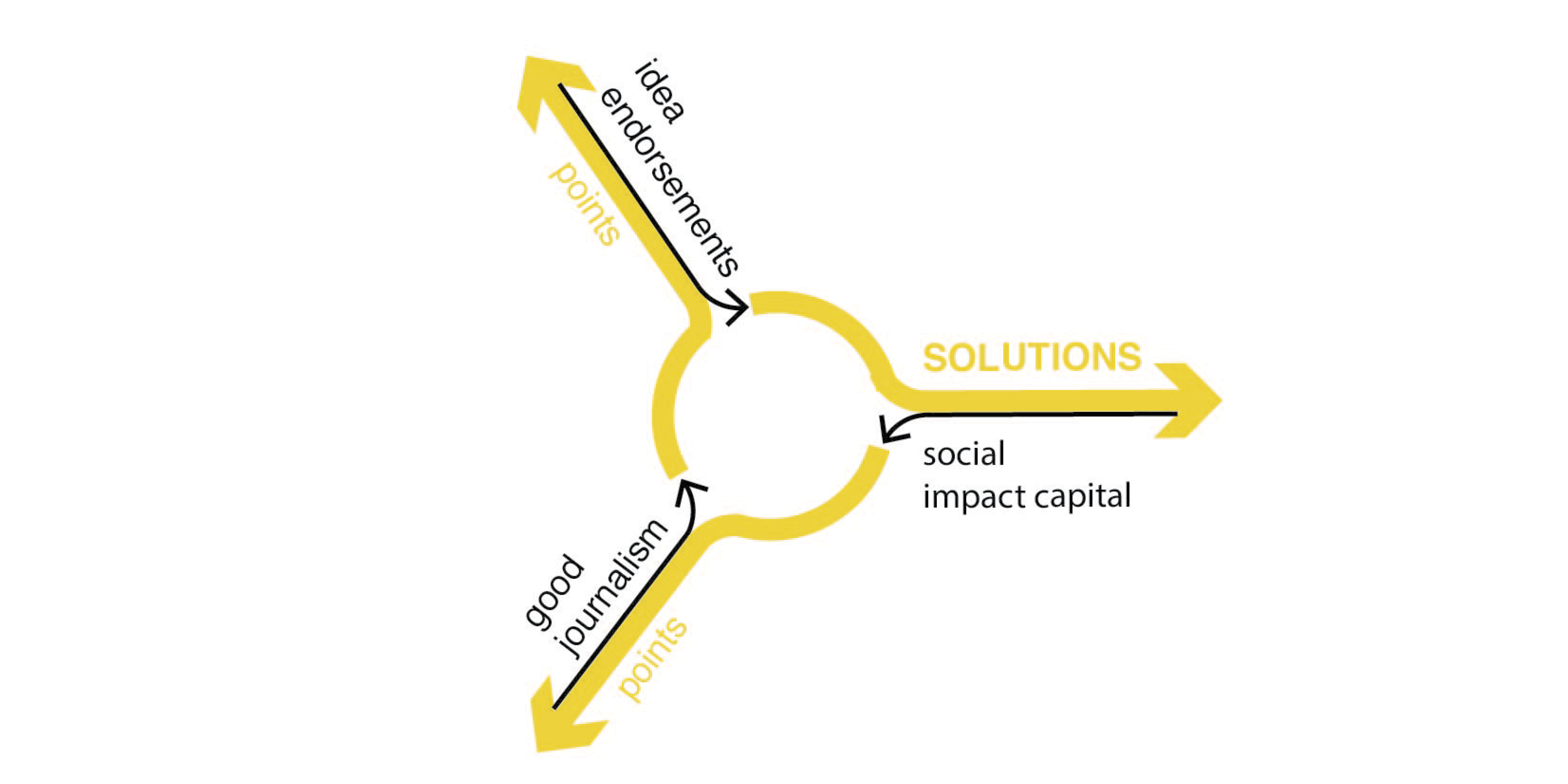
In a debate in September, Hillary Clinton said “we … need to have a tax system that rewards work and not just financial transactions.” What if this concept applied to verbal transactions as well? Lung Media attempts to re-link the economies of words and action by proposing to fund both enterprise journalism and idea endorsements using social impact investments, helping to direct support to projects of real value.
Our hope is to provide the soil, so to speak, from which we can uproot the tares of distraction and cultivate the wheat of good ideas, so that investors will want to stay engaged, journalists will feel (and be) rewarded for producing useful content, municipalities will want to sponsor topics for collaborative problem-solving, and, with support, people can work collaboratively on solutions they would like to see implemented by their elected representatives over time.
Amplifying individual voice in an information and decision-making soundscape dominated by advertisers and lobbyists
It seems that many problematic tendencies attributed to people today – an addiction to fossil fuels and junk food, for example – are ones that, while absolutely relevant and important to consider at the individual level, are hierarchically nested (that is, they are the result of decisions made when people start with a limited array of obvious choices). If alternatives are accessible, people may well jump at them, as has been demonstrated by ride-sharers and residential solar panel sales.
While individual thought and decision-making is still most important, and advertisers and special interests surely don’t always limit conversation and choice, wouldn’t there be a value in exploring a new information-gathering and concept-sharing paradigm that is independent of advertisers and special interests in order to maximize the chances of exploring ideas that don’t just look right or sound right, but may be more likely to be right?
The listening agency, which is a 2016 counterpoint to the advertising agency and constructive critique of the publicly-traded journalism brand, could be called a manual transmission able to mediate between the distinct, but related, forces of (I) problem-discovery, (II) problem-solution, and (III) solution-funding represented by the journalistic, educational, & non-profit sectors. Such an education sector agency would, in theory: raise up, rather than lean on, journalism where possible; help subtract marketing forces from the world; re-conceive of the K-PhD educational system as a circular rather than a linear proposition; and recognize the preservation of the idea of human equality as an essential cross-sector center of gravity.
I believe the listening agency model could transform policy debate by encouraging the reorientation of journalistic enterprises away from the pursuit of ad revenue and toward problem-solving, making workplaces safer for professionals doing the latter. I’m seeking edu partners & have attempted to describe my reasoning in full here.
 Recent Writing