
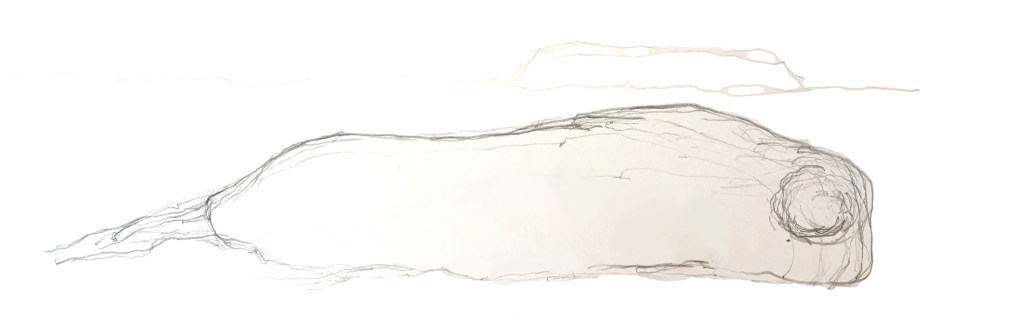
Quarantining has involved a lot of outward stillness and inward pondering; and it has been difficult at times not to identify with a pinneped like these on dry ground.
Like seals, people need to be relatively still sometimes; and I have been keenly aware of my stillness recently, as well as all that has supported it.
On Emissions
When I worked at a large media company, I noticed that there seemed to be two distinctly different factions within the organization – one, the vast majority of the outfit, which prioritized both ratings and journalism but that was partial to the latter; and, the other, a tiny but fast-growing department that heavily favored ratings as a governing decision-making input in programming.
What has remained notable to me about this is how much in common these two department-types had while, at the same time, having profoundly different effects on the world. All this seemed to have to do with which reason for existing governed decision-making. Soon, the small department was dominant.
As I have written before, once this threshold is crossed, an enterprise arguably ceases to have a positive net effect on the world and overlaps less well with I at least understand to be the definition of an American organization.
What felt particularly notable about this, to me at least, was how obvious a problem it had become but, at the same time, how much pressure there seemed to be to be quiet about it.
Perplexing Bonds
It continues to be striking to me today how much resistance there is to reform in the media industry – too often taking shape in an insistence on hiding and perpetuating growing problems rather than acknowledging and, thereby reducing, their effects.
More and more, it seems ours is a media industry that would create or ignore problems for no other reason than to later appear to come to the rescue, making a too-dangerous gamble of our collective futures.
But I also believe our media industry, working together with remarkable synchronicity, is dealing with more than a collective case of Munchausen syndrome by proxy.
On Degrees
Not long ago, I was required to take a class taught by a man who researched confederate memorial preservation. This topic being a part of the course, I listened – and responded – to a loaded comparison between more crass and obvious memorials and subtler ones, which seemed, to me at least, to be potentially more dangerous.
There is a big difference between being restrained and being constrained, of course, but both matter.
Not terribly long ago, I watched a film portraying the harrowing experience of a kidnapping survivor who, in one scene, awoke to find herself restrained – literally – by a cable attached to her ankle. Although I have certainly not ever been restrained in such a way, the thought that came to mind immediately and involuntarily was that this visual, illustrating a moment of both realization and horror, described the way I felt upon realizing, when first asking for help getting away from the Larry King Live team, that this would not be provided.
I was not restrained but constrained. Still, I often felt as though I could only move freely inwardly and by turning away from all that was going on around me.
Sometimes it seems as though both for-profit and for-power media organizations would allow Americans to see one another as enemies under an influence almost too subtle to articulate for the purpose not of restraining, but constraining dialogue. While this problem has been addressed to a degree in recent years, I still wonder whether we’ve left the most important dimension of the discussion unbreached.
On Tipping Points
There has been consistent talk about the importance of limiting global warming to 1.5 degrees Celsius in order to avert a cascade of heartbreaking consequences. But what about acknowledging and dealing more directly with the impacts of an overheating and outdated media infrastructure before its cumulative effects compound irreversibly?
On Pretenders
I have had the privilege of visiting gorgeous China and getting to know several wonderful friends there. I remember, before departing for the country, watching a documentary highlighting dangers to foreigners who spoke too openly, particularly about religion, there and reasoning I would need to simply be respectful and careful in my conversations with others. When a new friend asked me about my faith, I answered him as matter-of-factly and succinctly as possible, and I tried not to worry about what I’d learned from the film.
But when this same friend asked me whether I knew about what had happened in Tiananmen Square in 1989, I felt more apprehensive and am not sure I even vocalized an answer beyond a nod affirming that of course I did.
Actually visiting Tiananmen Square – unannotated – felt bizarre. Not because of its history only, but because of how sunny and normal a day everyone seemed to be having there. It seemed so easy, but was painfully impossible, to pretend. I still wonder, if speech (and acknowledgement) is limited implicitly rather than explicitly, isn’t it limited just the same?
It seems to me that it is imperative that we both cherish and protect the foundation of freedom upon which our country rests before it melts away completely. Once the barrier between journalistic and ratings-first forces is broken, it may be difficult to re-establish.
I am not slated to be vaccinated until next month; until then, here I am, still, flipping my flippers sitting on top of the ice – and grateful I still can.
.
 Recent Writing