
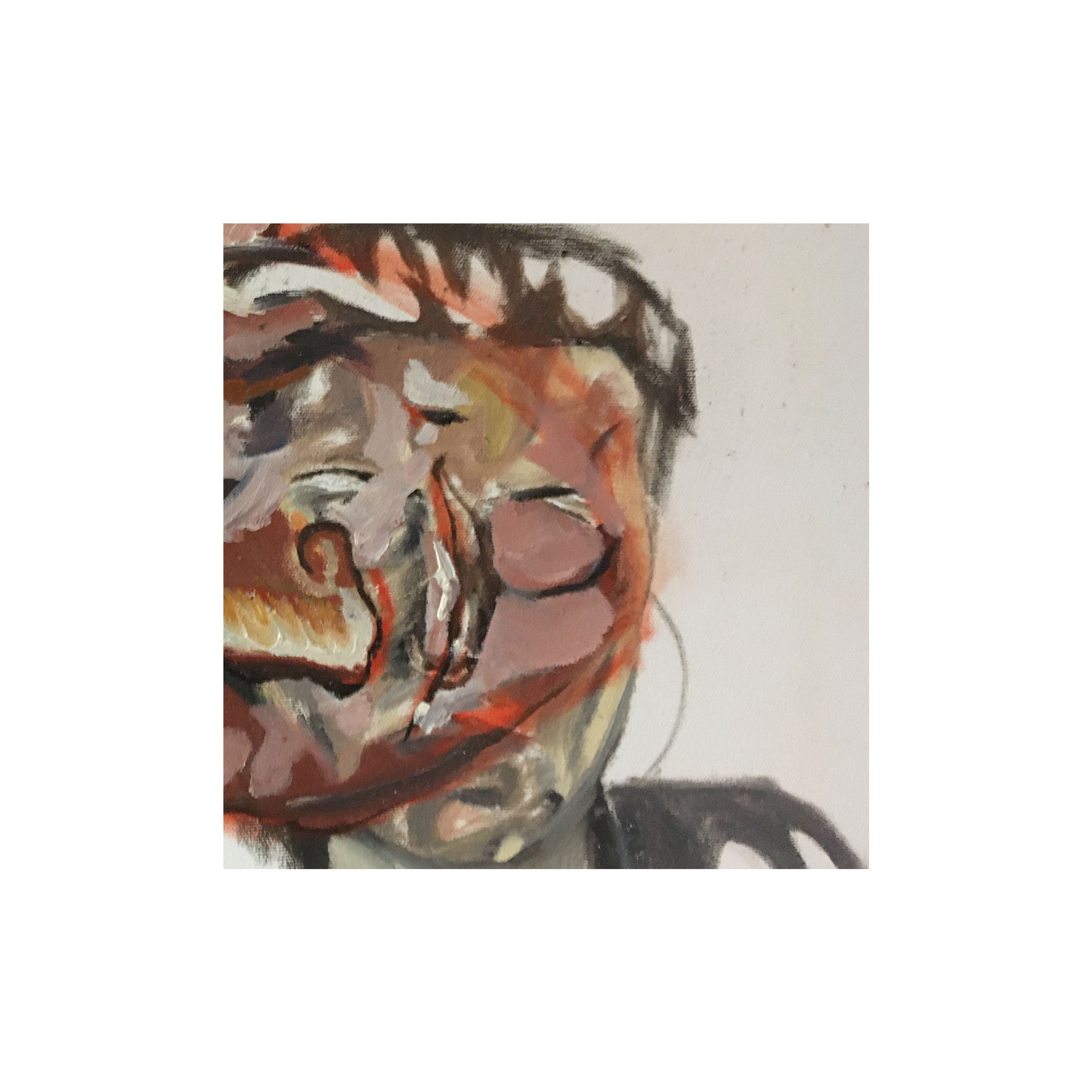
Recovering from a collision can be a particularly surprising process.
Recently, I experienced a car crash after which I felt almost unable to stop crying for days. While I have no memory of the accident (my car had been stationary and I had not seen the other car approaching) one of my first thoughts after realizing what had happened was of gratitude for the fact that I would not need to deal with remembrance of the moment of impact. Still, it seemed my body did, and wrestled tearfully with questions like, How is it possible for one object to strike another object so hard? Why do objects even exist that can do so? When will I stop hurting?
But all of these questions were ameliorated by the fact that car accidents, while terribly undesirable, are dealt with as such. I would never imagine calling a police officer or insurance agent after one and being asked what they need to do to make me pretend nothing had happened. Or, more relevant to the theme of this blog, I would never imagine identifying a faulty safety feature and being intimidated by a car manufacturer not to say so because of the magnitude of needed redesign costs. But it seems that for too many years this has been analogous to news organizations’ handling of problems.
On Means
What I experienced by the Larry King Live team at CNN is what is often termed the attempted “murder of the soul.” And I believe it matters much more than CNN has acknowledged.
Many raised in religious environments are told to “draw out” one’s soul to the hungry and “satisfy the afflicted soul.” But how can one do this without healing of the soul and a recognition that safety matters, including an acknowledgment of places where safety is not prioritized and, more importantly, methods by which it is intentionally compromised?
On Reasons (Ends)
I continue to believe creative education, in addition to a culture of compassionate accountability, could be an answer to the need to prevent vulnerable-ism not only within organizations but governments and may be one prong of a strategy that could stop kleptocracies from forming at all.
Such an education – focused much more on process than artifact – could help reorient young people from a focus on material goals to the prioritization of non-material ways of learning and contributing. In recent decades, there has been so much more of an emphasis, particularly among boys, on ends than means – on expected salary thresholds and an ability to brag about dominating other human beings, rather than on ways by which one may develop worth or add value to the world. In environments where such mindsets prevail, of course there is an obvious risk of boys becoming dominators. Of course there is an obvious risk of their becoming thieves.
If the resoluteness of Jordan’s belief that he had a right to mistreat my body – by leveraging a terribly intimidating and frightening situation to pressure me to allow him do something completely inappropriate – was a missile that, if it could, would derail the trajectory of my life forever, although he was certainly responsible for his actions, I still believe numerous organizations that stood to benefit from his aggression saw it coming a hundred miles away.
On Willingness
I have written before about how notable it arguably is that children can tend strongly to demonstrate a willingness to stand up to wrongdoers regardless of the presence of risk. “Children will often risk retaliation to police adults,” as authors Gail Heyman, Ivy Chiu Loke, and Kang Lee put it as referenced in an earlier article. And “children commonly engage in policing even in the face of potentially negative consequences.”
I love the idea that we are all to strive to become more childlike – a quality that, like childishness, does not necessarily correlate with chronological age. Ukrainian President Volodymyr Zelenskiy has expressed this dimension of childlikeness so beautifully.
Recently, I found an MSNBC interview between host Ari Melber and former Russian Foreign Minister Andrei Kozyrev notable for the following exchange:
“Is there anyone within the Russian government who can even give [Putin] … bad news? I’m not even talking about overthrowing him, but give him bad news to course-correct, or that’s, in your view, out of line, not going to happen?”
“That is less possible than overthrow him,” the guest responded. “That’s a Russian tradition … they … fear to tell the boss the truth.”
Listening to a podcast the other day, I noted that pundit and conflict expert General H.R. McMaster articulated a helpfully simple and elegant equation describing deterrence: capability times will. And I realized, this goes in both directions.
To be childlike may simply be to be willing.
I have also written before about how much I have personally been touched by the story of boxer James Braddock, known, well before the eponymous film, as Cinderella Man. But, after seeing the beautiful movie about his extraordinary life again several months ago, I felt inspired to watch a clip of an actual fight he’d won; and I noticed something striking. While not depicted in re-enactments, when the real Braddock knocked a fellow boxer to the point of a fall, he instinctively lunged to cradle his opponent’s head with his glove to ensure it did not hit the ground. James Braddock was a sportsman: he knew he needed to fight to win, but he intended no harm.
On Impact
When first realizing I may need to leave CNN in order to separate from its talk show unit in the months after agreeing to work for the Larry King Live team, I remember feeling a sense of shell shock. While I never articulated the analogy to anyone, after giving my notice I identified emotionally with the boy at the beginning of the film Arlington Road when asked why I would leave CNN at all.
One reason I continue to request that my experience be properly acknowledged by CNN is that I believe such an acknowledgment would be just and, moreso, I believe it would be important to help prevent any other person from experiencing the same or having to respond to such ridiculous questions when the answer should have been obvious: something terrible must have happened.
 Recent Writing