
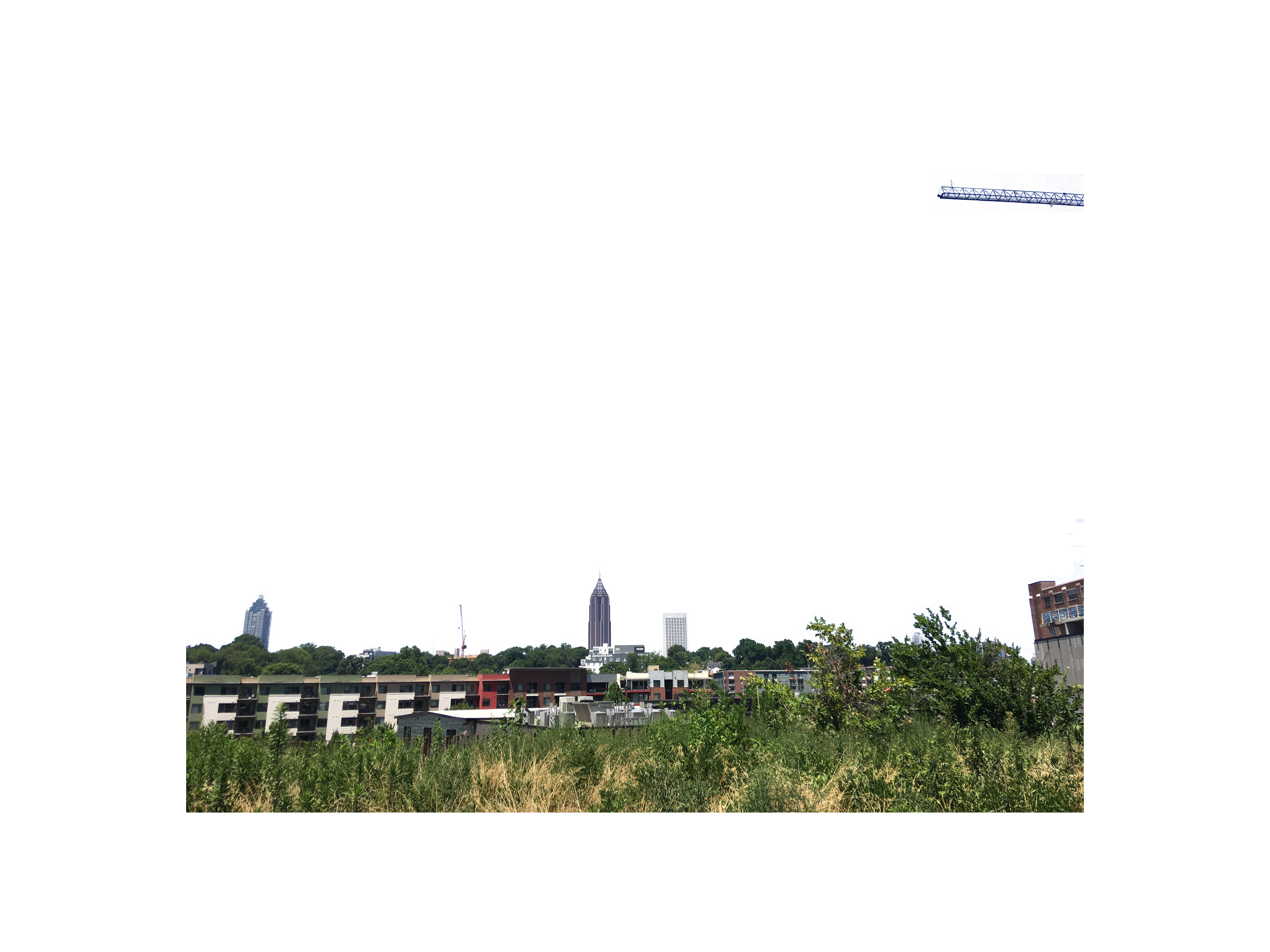
I just got back from a long day. It always gets me, visiting Atlanta’s Old Fourth Ward, home to me for several years of my early professional life and a locus of urban transformation I have found inspiring over a period of years. (For how long did I dream of buying and transforming a particular building near my old home that, thank goodness, is still there?)
The second time I ever visited Atlanta, my dad had a business trip planned and invited me to come along. Having been freelancing in Washington for an Atlanta-based news organization for awhile, it felt like a good opportunity to visit in person, and I’m not sure I’ll ever forget how it felt taking rapid transit all the way downtown from Dunwoody. I remember realizing when I got there that it felt like a good idea to buy new shoes and being so grateful to find a Macy’s downtown. And one running a store closing sale, yet.
On Decay & Restoration
When I moved, I felt sure I wanted it to be downtown, and I remember when my mom helped me tour apartments, mapping the walk to my new job from my new apartment. It would be so easy to walk to and from work every day, we reasoned, and we decided to do a trial run. Thank God we survived.
It was only then that I began to realize what the closing store had signified: A downtown that, while given a jump start by the Atlanta Olympics about a decade earlier, was still in trouble.
A lot has changed in the Old Fourth Ward, which I visited for a work assignment this week; but, while someone’s painted over my favorite Kodak mural (Why???), it still feels like home to me.
Whereas a Macy’s showroom was closing when I first arrived in the city, the old abandoned Sears Roebuck building is now bustling, having been defibrillated by what could be termed a sort of heart surgery in the form of an activated BeltLine.
For so long during a period between long residential tenures in this neighborhood I would not even drive near this part of the city, convinced it was my duty as a person of faith to always look forward. Never look back. It wasn’t until I searched my heart for an explanation for a sense of homesickness that did not go away after moving that I had the courage to listen to it’s answer: “I never told you to leave.” I was so glad to move back.
Still, I’m by no means not the only person who’s felt led by the heart to pour into this “Renaissance” section of Atlanta, or, Buttermilk Bottom, as it was formerly called. And thank goodness. While the Renaissance period was arguably a great one for helping move downtown Atlanta in the right direction, it did not go far enough.
While all this was a long time ago, I’ve felt relevantly inspired to think about parallels between effective physical infrastructure improvements and those to communications infrastructure by today’s excursion. What, I’ve wondered, made the BeltLine possible? And what made visionary Ryan Gravel successful in seeing his proposal realized, at least to the (very significant) degree that it has been?
It helped that he is a man, there’s practically no doubt. There were also virtually no opponents remaining to the kind of progress he proposed. (The story of the BeltLine may have been different if Gravel needed to lobby a city council headed by a tire or auto company executive in order to implement it, for example.) But, beyond this, Gravel was resourceful, patient, and persistent. He was also collaborative; but I wonder what lessons are to be learned from what seems to have been a degree of drift from an initial focus on equality in the early phases of the BeltLine’s construction leading to several high-profile resignations, including Gravel’s, from its board in 2016.
How is it possible to put an idea into the world, intact, and do your best to ensure it will not devolve in mission-critical ways? Regarding the theme of this blog, I continue to believe a journalism sector insulated from market forces is a critical component of an intellectual environment conducive to innovation as, while public dialogue has evolved to better acknowledge the rights of women, what protections are there against abuse that continues in private, and in places where there is no one to address it?
Given the Supreme Court’s recent decision with regard to abortion rights, I feel it may be becoming more important than ever for dialogues about difficult topics to focus as much on the why than the what of individuals’ positions in order to make room for sustainable progress. (As with recent riots of all forms featuring two distinct and opposing sides, it feels essential to ask, before championing or condemning anyone: what happened in the lead-up to this situation?) While I do not have any personal experience with abortion or many other related matters about which women have recently spoken, my experiences have still helped me understand why it is essential to talk about ensuring equal rights for women in America, including within organizations that seem to overcompensate for internal inequalities by taking hyper-partisan and inflammatory stands on political matters publicly. This is as it seems that, like many public spaces, public affairs need to be defibrillated, or depolarized; and, while it certainly does seem like we are entering into a new era, what if a more pro-life focus involves a broader complement of policy changes that help reduce situations in which women feel hopeless or pressured to become pregnant against their will?
What if, as in physical movement around Atlanta, we need to realize that there is a need, not only for a 75- or 85-like superhighway between poles, or even a distant loop encircling important places, but for topical destinations in public affairs dialogue where acknowledgement, interaction, and actual traction in the form of solution-design and building can actually occur? I love how, in the already-mentioned film Defending Your Life, Rip Torn’s character describes to Albert Brooks the perplexing problem of getting “stuck near the inner circle of thought.” But what if our problem is exactly the opposite?
A great deal of attention is given to local news as a counterbalance to a too-overpowering national news media. And, while I agree wholeheartedly with those who advocate for deeper local engagement, as I have written at length, I continue to believe that an as-important focus for new media business model development will be less on physical and more on intellectual neighborhoods, or nodes, of engagement, anchored by documentaries.
On a Post-Word World
Something one hears first, and often, in learning how to mediate disputes, is about the importance of acknowledgment. But our media infrastructure seems to resist an inherent responsibility to do just this when it comes to this industry’s own harms to our world.
Everyone knows that a map of any particular place is distinct from the territory it signifies. But what if our current public affairs maps fail to show very much at all of the territories of thought where, with a little bit of attention, and a return for more helpful journalism, a few simple rearrangements and design solutions may help catapult us all forward?
In a sense, I believe it may be no longer be accurate to call ourselves living in a post-truth world, but absent media sector accountability, more of a post-word world. (What would be so terrible about a measure of accountability in the media sector? What would be so problematic about dialogues regarding media company business models being heard out loud?) I believe that, at the heart of such dialogues is the question of whether a small number of people have truly, and suddenly, evolved to the point that the checks-and-balances structure of American democracy is no longer needed or legitimate as this does seem to be the position taken on by most oligarchs affiliated with media orgs.
One reason I believe that handling the problem of gender-based discrimination and disparity within news organizations is that its perpetration seems to be the main lever by which such organizations establish and maintain what could be termed an improper hegemony over the country. And an additional danger of succumbing to pressure to avoid the question entirely is that if media executives have not yet evolved to the point of obviating the need for our governmental structure as framed, and the stock market-dependent media model truly is the primary machine part causing our democracy to break apart, it is likely to continue to seek and assign the role of scapegoat.
Presuming we all want what is best for the world, let’s confront the idea that our current communications infrastructure requires a scapegoat at all – and at least consider beginning the work of redesign.
On Expansion
I have written before about a belief that what may be throwing so many people off in understanding what seems to be threatening our democracy today is a failure to conceive of debate on the topic as existing in three-dimensional space, featuring an axis along which it is possible to be conservative or liberal along a social axis, an economic axis, and a non-corporate media speech axis.
(I personally am not particularly liberal when it comes to some forms of speech, including hate speech. But I am liberal when it comes to speech that critiques corporate media business models; and it seems this is the form of speech most aggressively discouraged, if not censored, today.)
I continue to call on all those able to eliminate productions or positions that, as a result of these business models, involve the acquisition immense influence but require almost no expertise nor mandate to add very much, if any, value to the world. Such environments only seem to attract a corruption that affects everyone. And I do believe saying so is important.
It increasingly seems to me that any media organization that disagrees – and particularly any that has silenced women and suppressed solutions – would do well to consider appending its masthead with a more descriptive title, calling itself “The [fill-in-the-blank]-Post.”
 Recent Writing