
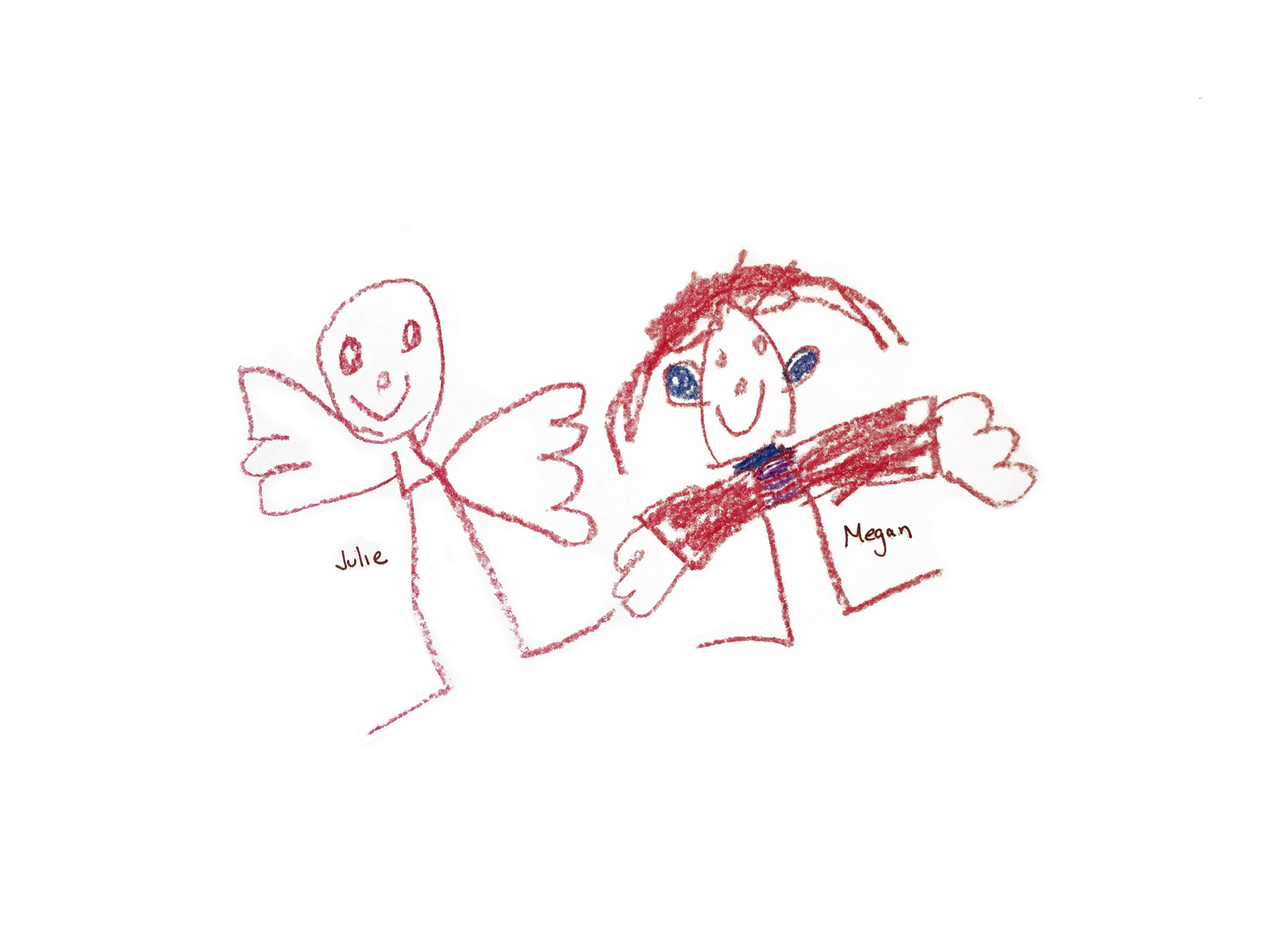
When I was little, I went through a brief phase as a beginner artist during which I could tell there was something important I needed to add to my drawings, but I did not know what. But, soon, it dawned on me like a bolt of lightning; and I remember reasoning, people need belly buttons. (In looking for something else, I loved coming across this drawing today.)
On All We Need
Last month, for the first time in what felt like ages, I got to speak about what I love most about journalism; and I adore expressing what a joy it is to discover a new, seemingly missing, or inspiring form of understanding and help put together puzzles. But, this week, I am film-judging; and it always gets me, seeing extraordinarily informative, beautiful, and galvanizing documentary films that I know far too few people will get to view. It can’t be that only a few people will see these films, I often think. We can’t bear that level of waste. It just can’t be this way moving forward.
One of my very favorite kid movies is still Space Camp; and I’ve felt reminded recently of the famous scene where the film’s NASA scientists finally realize the kids one of their robots disobediently helped launch into space without a functioning speaker system (Space Camp is so good) are attempting desperately to reach them using Morse Code. While there has been some progress, I feel a little like this every time I have the privilege of judging a new group of spectacular documentary films, many of which, I believe, could have as significant an impact on the culture as Blackfish or Voyage to Kure if only people were encouraged to dedicate more time to watching them.
I have spent so much time over the past several years trying to do something about this, wondering all the time whether my experience of gender-based abuse in news has affected the degree to which I have been heard. But I continue to believe that every ingredient we need for an improved communications infrastructure is present. Our current system only needs, I believe, to be rearranged.
Still, while it might be the little girl from Plymouth in me talking, in recent days (and months) I have wondered about the question, am I right? (Or, are many media companies’ seeming assertions correct that traditional journalism is no longer needed, and that our democracy is practically worthless?) I feel it important to appreciate that our country’s founding structure – built, many believe, partly on Native American principles – gives the whole world a series of ideals against which to measure ourselves. And even small changes toward these goals that several documentaries in recent years record prove that the needle is moving. But more collaborative changes would arguably be better.
I love learning about how, in migratory formations, birds take turns holding different positions in order to help their groups along, dividing hard work. In a so-called post-truth world, or in a world without journalistic accountability, every person needs to do her own journalism. Redundant work, in other words. Without a more functional media infrastructure, we are like a network without order. But if communication is going to be essential to our ability to collaborate, and if every team member’s greatest need is to be able to contribute, we need to include everyone and the solutions each bring to the table. So much needed work is already being done (and by people who love doing it), only falling on deaf ears.
For progress far beyond the individual scale, we need a world in which women in particular are welcomed to contribute.
On Just Enough
When I was little, I sometimes practically felt like an alien; but I’ve only recently begun to appreciate how many people are familiar with feeling this way. The opportunity that recent lockdowns provided for introverts, in particular, to be heard opened up a whole new world for many as not all of the world’s creatives punctuate their contributions with jazz hands.
If it is true that the three, childlike, qualities capable of evading corporate capture are honesty, courage, and creativity, we can’t afford a communications infrastructure that risks wasting such qualities on a large scale by failing to recognize them. Too often, it seems, the figures starring in our most prominent narratives are not the cream rising to the top, so to speak, but distractors less frequently discovered by media organizations than cast.
Journalists are incredibly important contributors to society and helpful critique is, of course, essential; but, like an unchecked algae bloom that would choke an otherwise healthy sea, the law of diminishing returns sets in quickly in the absence of any entity permitted to critique journalistic organizations themselves.
More and more, it seems, journalistic organizations are signaling a recognition that there are needs for appreciative forces where, in the absence of any sort of counterbalance to corporate media, critical forces have begun to dominate. And this is true. But, never having been a priority, appreciation does not tend to be journalistic organizations’ strong suit. And, for too many years, they seem to have engaged in just enough problem-solving and just enough appreciation to discourage others from getting in the game, so to speak. But we need all hands on deck today. (Yearly awards ceremonies are great, but problem-solving and appreciation need the lion’s share, although not all, of all our attention 365 days per year; and I still believe a listening agency model may be worth considering.)
In day-to-day business transactions, we express gratitude by offering a currency that enables a person to meet a need or purchase something enjoyable or enriching. We don’t just reduce harms, like, for example, limiting the number of cheeseballs we throw in their face that day. There are incredibly important needs that journalistic organizations serve; but I believe their currency of criticism, especially when directed principally at those who would voice a need for an appreciation-based sector able to counterbalance corporate media influence, may be getting out of balance. Journalism is and will always be an indispensable component of our communications infrastructure. It just seems to me it should not be its only component. Journalistic organizations need to continue to do their work. And they should, further, be appreciated for it. But where unhelpful critique proliferates, it arguably gives rise to a society of the too-careful. Creativity, often, thrives where there is encouragement; and in an era of seemingly very big problems to solve, I question whether we can afford an atmosphere of such risk-aversion.
Journalism organizations are essential; and, as wonderful as it is that they seem to be beginning to recognize the need for a more creative, appreciation-based sector, rather than abandoning their work, silencing women, and attempting to pick up this mantle alone, its arguable that what’s most needed is for them to do their jobs and allow others to do theirs.
On Visible Mending
There has been so much talk recently about the value of circularity (and it is important to eliminate waste); but I don’t think the kind of stasis implied, applied to every aspect of life, is necessarily what America is about; and while the media sector has perfected the art of the build-up-tear-down, there seems to have resulted an utterly unnecessary lack of progress on many important matters.
I love the idea of celebrating progressive improvements where they are needed. We all feel like outsiders, I believe, at least until we are permitted to make needed changes as we are all uniquely equipped by God to contribute.
While I by no means want to tear down our existing communications infrastructure, I believe it may need to be said that the defining characteristic of permitted news headlines moving forward cannot be whether they call into question news organizations’ hegemony over America. Our country’s communications infrastructure has during many periods done immense good, and I believe it is important to continue to emphasize that. But perhaps this is a time, not just to acknowledge, but to build on, practical beginnings.
 Recent Writing