
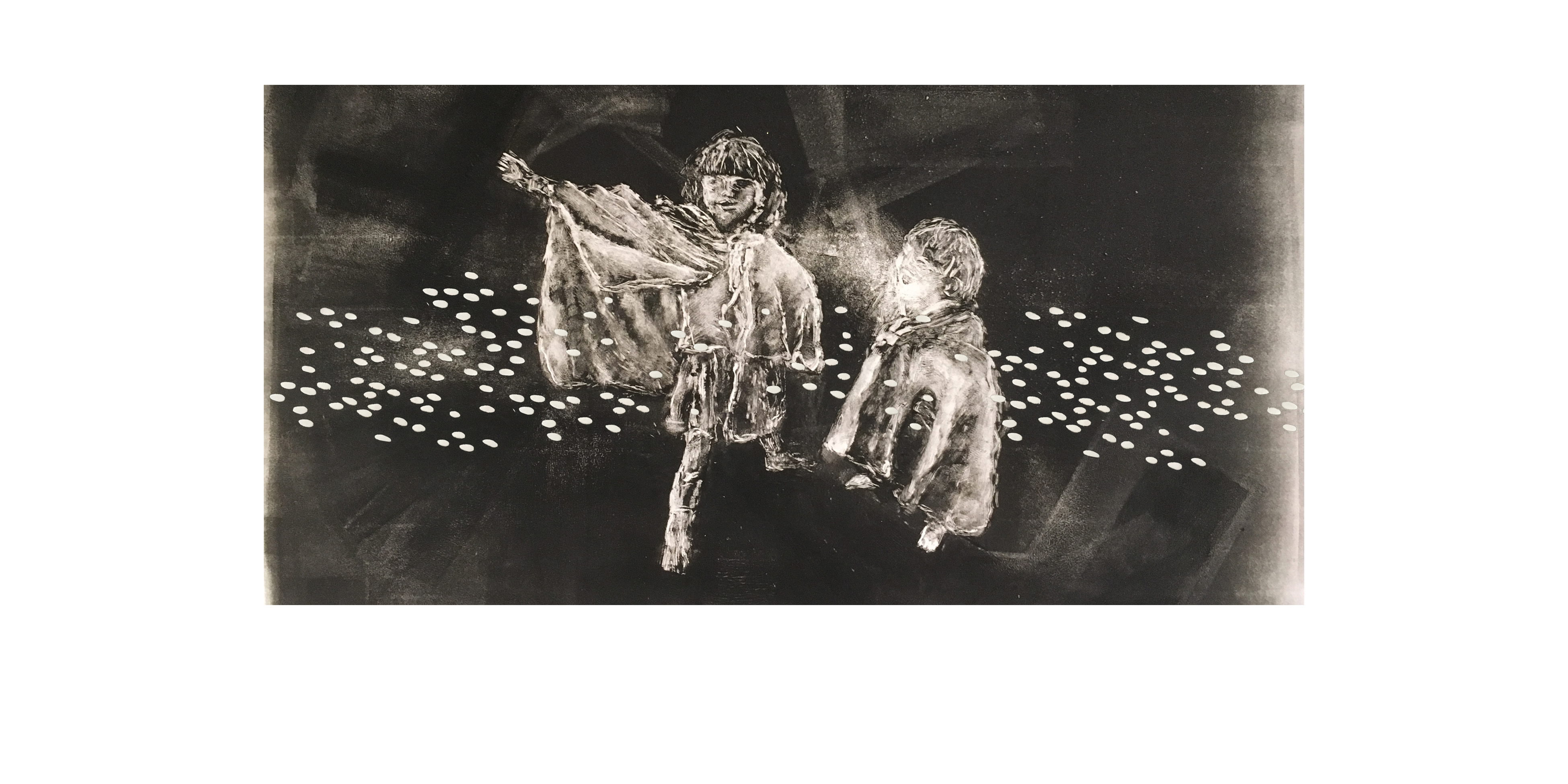
This morning I woke up after a dream featuring a childhood friend who passed several years ago. In it, we were just hanging out in a group, about to put on a movie when I realized that – I guess because he knew how much I love dogs – he had installed dog furniture on my ceiling. (I think, in this imaginary world, gravity affected people and animals differently, so buildings somehow held us up and dogs down.) Anyway, I awoke feeling the sweetness of this gesture, but – more than that – even though I knew it was just a dream – enjoying how, boy, did it feel good, seeing and hearing my friend. Of course, it wasn’t the same.
On Dreams
When I was in the 9th grade I had a realization that served as an important lesson and that still feels like an important guide. Although, as a kid, I absolutely loved daydreaming, it dawned on me heavily one day that every time I did so, I might literally be assuming God’s ideas for my life were not as good as my own. Immediately, I determined I needed to fast from my musing and resolved, as the challenge felt right, to try this for ten days. Even when I needed to go for long stretches simply aiming to think of nothing at all in order to accomplish my goal, I put my full effort into it and, after a few days, something seemingly miraculous happened… The boy I’d considered the most handsome boy in my entire school asked me out without ever having given any indication before he’d even noticed my existence. This was not just any boy but was in the 11th … grade – a veritable man of the world – and even already sported a beard.
I’m not sure I’ll ever forget the moment I opened my family’s front door to an unrecognizable stranger:
“What happened to your beard?”
“My mom made me shave it off so I wouldn’t scare your mom. Do you still want to go to the movies?”
“Alright.”
I don’t think our conversation got much more interesting from there, I felt so nervous, but it didn’t matter. I’d learned my lesson about paying more attention to God’s ideas than my own; and this has proven helpful in so many ways over the years.
Wishes
Some years ago, I listened to an interview of the creator of one of the world’s most successful fictional television series and was struck by one of her strategies in writing: wish fulfillment, as she described it. Watching the show, I got to thinking, “why on earth am I listening to this boring multimillionaire character?” And the answer, I realized, was that the show encouraged viewers to imagine being her.
Recently, I’ve wondered whether the same dynamic is at play given the phenomenon “The Crown” – a show I must admit that, aside from clips, I have never seen – has become. Why would people, and Americans in particular, be so intrigued by the internal dynamics of the British royal family as to make fictional depictions of it so profitable?
And Realities
For so long, I have dreamed – in the waking, aspirational way – of a communications infrastructure characterized by engagement and fruition – not distraction; and, while I know it looks a daunting challenge, I still believe this hope’s realization to be possible.
But, as being heard about this idea has seemed so difficult (which is a step up from impossible-looking) it has increasingly felt worthwhile to examine why.
While, at first, when, as far as I knew, I had been the only person to have ever felt gender-based discrimination in journalism corporations may be a problem, it seemed like my best option may be to attempt to forget about my latter years in news, other women’s stories helped me see that what I encountered may have been part of a pattern that could be understood.
While an imperfect analogy, it almost felt as though I’d seemed to be battling some sort of perplexing problem like a mole of some kind to which I’d resigned until I saw it begin to morph into a cruel word indicating I was not facing an impossible imposition that could not be solved but what began to feel more like a bad dream from which women in general could emerge.
But this felt more challenging after I considered the proximity of the man whose behavior seemed to lead to so much of this trouble, not only to the now-former president of CNN, but to the Hollywood women who seemed to orchestrate what may be called the corporate capture, or co-optation, of the women’s movement. I believe this man’s next girlfriend, and then wife, was even placed very close to my old job, so I did not know where to turn.
While I realize my own concerns are specific to me insofar as, to the degree it feels like we are no longer the United States of America but, rather, the United States of Media Companies, I feel less like a citizen and more like a refugee, and other people may be experiencing this to a far lesser degree, it still seems that the question of media corporation business models ought to be a matter for public dialogue.
Despite all this, I still have so many fond memories of CNN and certainly want the organization to succeed. I just question whether it and/or companies like it should practically run earth without ever having been elected by anyone and without ever being accountable to anyone.
On Reasons
Recently, verbal attacks on various racial and other groups have appeared to increase at the same time proposed solutions to many of the problems that persist in media companies’ entertainment- and distraction-centered business models continue to be stifled as scapegoats seem always to be sought in such situations. To me, the rotation of pent-up anger and blame for such unsolved problems seems not unlike the ebb and flow of the stock market, which fluctuates cyclically but whose fundamentals remain unchanged and overall volume, as a result, seem to increase indefinitely.
Given this uptick of [senseless] tension expressed by those who may feel increasingly feel impoverished and unheard without knowing why and who seem to want to imagine this to be the fault of one or another ethnic group or religion, might this not be a good time for the bipartisan matter of journalism corporation business models to be addressed?
Maybe imagining does seem better than nothing. But it still feels to me that the headline today – and what could at least be called some good news – is that “nothing” is not our only option. Regardless of what the best alternative to a ratings-first informational infrastructure is deemed to be, I still wonder whether, if media corporations’ business models could be improved, solutions to many more of the world’s problems could potentially break through and help lead us forward.
 Recent Writing