
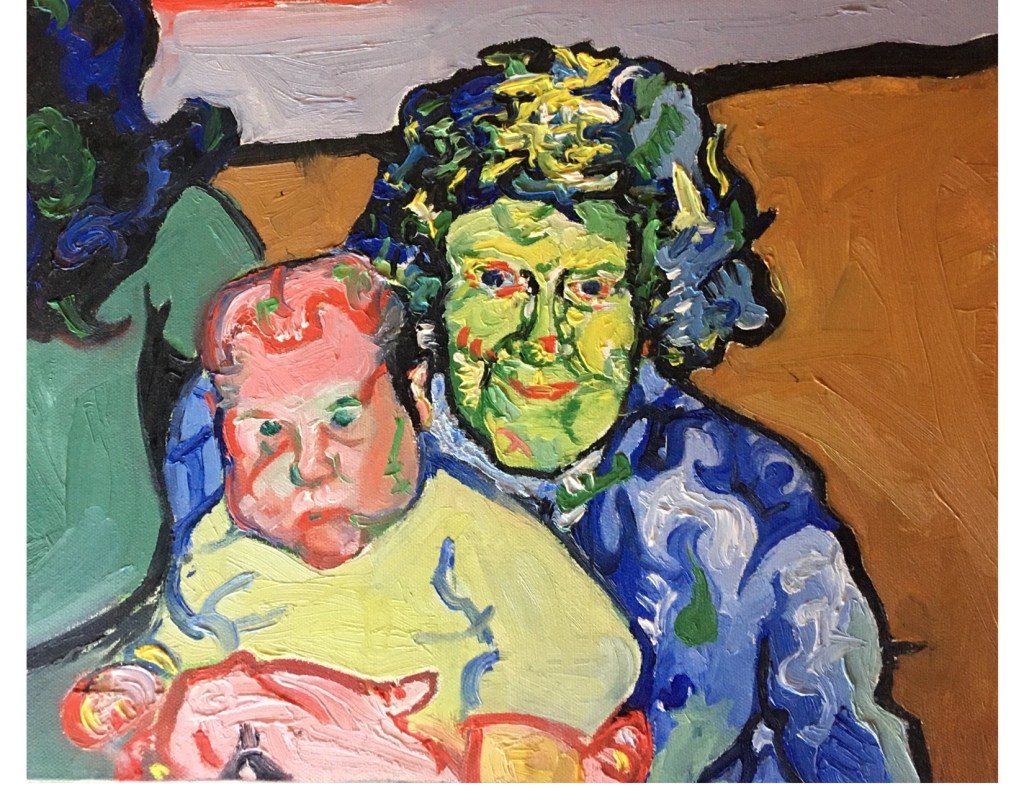
Last night, I watched a biography of Vincent Van Gogh before walking past a print of one of his sunflower paintings I walk past every day but that, this time, resonated much more deeply. I’d learned so much I’d, devastatingly, not known before, listening to what was clearly a lovingly-researched retrospective on an unquestionably remarkable life; and I have been inspired to feel great compassion for Van Gogh’s clearly loving heart, and intrigue at his independence of thought, since.
Generally speaking, and particularly in finding his place in the world professionally, Van Gogh was arguably not, like many people, an insecure electron looking to attach himself to the already-established wealthy and popular but sought, rather, to highlight real and under-appreciated value in working people and the earnestness of their lives. I found this particularly inspiring given that his home, the Netherlands, had been the birthplace of the modern stock exchange as, maybe sensing something was wrong when no one around him did, Vincent Van Gogh, rather than only speculating on value, resolved to add value to the world instead; and he did.
Another documentary revealed that Van Gogh saw sunflowers as a symbol of himself and that, despite the heart-wrenching and tender attention he invested in each stroke of his brush, he didn’t expect his work to be understood before years had passed. He gave of himself, in other words, and he did so with notable selflessness.
Still, I felt disappointed that it was only in watching a film that I learned that this famed visionary, about whom I’ve read and heard often throughout my life with too much of an emphasis on the tragedy of his famously heartbreaking act of self-harm, did not simply remove a body part one terrible day for no reason but had, only hours before, pursued a friend (Paul Gauguin) in anger with a blade only to stop himself and run away. Van Gogh, who also very well may have been suffering from lead poisoning, had been, earlier in life, known to look at his shortcomings squarely (and, arguably, far too critically) and punish himself in order to improve.
Considering this, and I do hope no one is offended at my saying so, I felt reminded that even Jesus advised taking some acts so seriously that cutting off one’s hand or amputating one’s eye would be better than committing them. Most, obviously, believe the strong language used in the Sermon on the Mount to communicate this message was meant to be taken symbolically. But, knowing what had occurred just hours before Vincent Van Gogh perpetrated this awful injury to his own body, I wonder, in remembering the quality of his heart, may it not also be worth considering what he may have considered his reasons to have been?
I love how, in 1963, Frank X. Barron wrote in Creativity and Psychological Health “the creative person may be more primitive and more cultivated, more destructive and more constructive, occasionally crazier and yet adamantly saner, than the average person.” Whether it was better understood as his contribution or his curriculum, Vincent Van Gogh took his purpose to remain focused on uplifting the downtrodden personally – and seriously.
I loved retrieving the old self-portrait homage to Van Gogh, above, painted in, I believe, high school, from a photograph with my great-grandmother, anyway; and I felt reminded today to ponder this enigmatic thinker’s contributions to the world, his aim setting out having been so gorgeously noble.
On Fixedness
What prominent figure since Van Gogh’s time has leveraged such a signature creative gift to question topics as important to the world as the need to understand root causes of poverty?
I read an article today from the world’s leading newspaper company praising a popular musician for encouraging her fans to get credit cards from a company with which she is affiliated in order to build their credit. While I am in no position to judge this very talented musician, I still felt impelled to ponder the purpose of art.
If it is true that unaccountable power is attracted to unaccountable power, cronyism being corrupt systems’ best defense against reform, should we not still pause to wonder whether a world informed by publicly-traded communications companies, their mode of operating arguably being so incompatible with human nature that their very presence may work against the well-being of society as a whole, is informed at all?
Many artists understand intuitively that the act of adding net value to the world sometimes seems to result in poverty within broken systems. But many persist anyway. Why?
Earlier Christmas evening, my family watched the Christmas classic “Holiday Affair,” and one of gorgeous Robert Mitchum’s lines when addressing Janet Leigh’s character’s concerns about marrying a modern nomad resonated deeply in my heart: “I want a girl that’ll (sic) drop everything and run to me, no matter what the score is.”
This feels, to me, like what, with regard to individual callings, everyone should endeavor to be willing to do. I thank God for people like Vincent Van Gogh, who persisted in exploring their understanding of purpose, despite adversity, and perhaps because they knew that the scoreboards of their day were broken.
As easy as it can feel to rest on a hope of finding some sort of human advocate or partner, like Van Gogh certainly had, before proceeding with what feels like an important project, it may be essential, in light of the independence he modeled, to consider the possibility that that might not be everyone’s assignment. Sometimes one does need, for whatever reason, it seems, to speak alone because, as part of a larger symphony, we each play an singular, and interconnected, role.
I heard a lecture the other day from a woman who talked at length about the idea of what, in her religion, are termed pre-mortal covenants; and, while I am absolutely no expert on her faith, I have heard similar topics discussed in helpful ways before; and the notion that, on some level, we are all cognizant of our individual purposes felt immensely inspiring.
Even if he forgot, and back to the documentary, I wondered whether Vincent Van Gogh, who was preceded by a stillborn sibling, agreed to be born to a brokenhearted woman he knew would never love him out of the tenderness of a beautiful heart and whether God paired him with a brother, in response, who would love him no matter what. While I am no Van Gogh scholar, it seems to me, in his best moments, he let the foreknowing of his heart be a nerve that gave him the nerve to fix his mind’s eye on what he understood to be his God-given role as an advocate for the poor within an immoral economic framework.
And Continuity
Does not the work of advocacy on which Van Gogh, and others, have embarked remain undone?
While, in the 1980s, as the stock market economy roared and men, seeking worldly success according to popular measures, abandoned their families in droves, it was obvious to the observant what undercurrents were distorting otherwise clear pathways to progress for Americans. But, what, at that time, was arguably an almost insufferable game of hide-and-seek between Wall Street and a less profitable, but more virtuous, journalism sector seems to have devolved, with the merger of the two, into a simpler, and arguably much more deadly game: Hide.
While it is true that today, when pressed, journalism corporations do not only value-signal, but produce journalism that both acknowledges meritorious achievement and identifies barriers to the enjoyment of equal opportunity for all people, this only seems to occur when their hegemony is threatened by the clear-eyed, and it only seems to be allowed to the degree that their hegemony is maintained – an arguably massive problem.
But can an informational infrastructure within which only followers are platformed really lead us anywhere?
I continue to believe these entities’ relationship to the stock market, given its historical influence on the world, requires deep consideration. (Before its constitutionality was questioned, hasn’t the modern stock market historically tended to be a root cause of net destruction to the intellectual, artistic, and natural worlds? And is this discussed enough?)
As drastic a position as it may seem, sometimes I still feel journalism corporations’ relationship to this kind of machinery may be to blame for many more of the world’s problems than is normally acknowledged; and I wonder, would it kill us to cut it off?
 Recent Writing