
I don’t think I’d realized it consciously until it became undeniable how singularly-themed my practically animal-rescue-only Instagram feed had become. But I’ve begun giving thought to why it is these are almost the only posts presented to me anymore.
What is it that is so inspiring about the sight of a wild or rehabilitated little creature being given the opportunity to, in safety, express his or her fully genuine identity?
In particular, I’ve noted in recent months how delightful it is to be able to note the evident mindsets of protected gorillas typified in little adolescents’ performed decision-making processes, sizing up the distance to a desired destination before, predictably, opting, rather than walk or crawl, to somersault there instead.
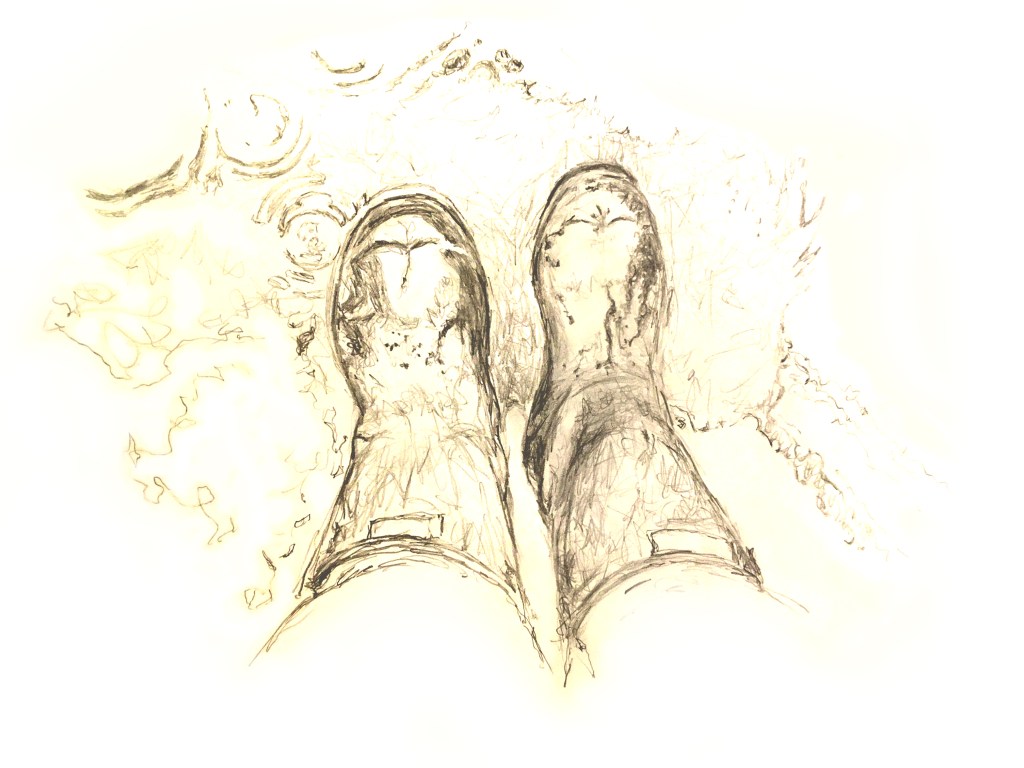
And I’ve considered this a couple of times recently when waking up to a realization that the day ahead would hold a considerable amount of rain or other adverse weather I could either avoid or embrace. Lately, I’ve been grateful to feel a sense of delight when realizing I would be able to, for example, clomp through puddles in my wellies, dress up in a favorite winter outfit one last day for the season, or simply revel in the knowledge I live close to a nature preserve where I can always take in a long hike or run despite a little chill in the air.
I’m so grateful that, over the course of just a few minutes, today, I experienced the sweetest series of events. Beginning with the rescue of a little worm, whom I named Donald, perplexingly stranded in the middle of a brightly sunlit sidewalk, this went on to include friendly and close interactions with two gregarious robins – Charlabelle and Mabel – who, evidently, didn’t hold my worm relocation project as a grudge against me and helped confirm my choice to take the long way.
On Shortcuts
As I have written before, I believe, as a country, we may be taking some unhelpful shortcuts today whose harms – not to mention, importantly, opportunity costs – should be considered more deeply.
Particularly as public dialogue has increasingly begun to target people, rather than policies or concepts, in addressing what are certainly systemic problems in need of solution, it feels especially important now to collaboratively identify – and address – relevant suboptimal systems and norms in order to avoid devolving into even more of a merciless cancel culture still wracked tomorrow by the same senseless problems it has been for upwards of a decade and a half now.
While I still feel a series of watershed moments signaling a sort of transition from fact-based to more expedient appearance-based dialogues happened in relatively quick succession during the mid-aughts, more recent signals have been getting increasingly overt. And I strongly believe there to have been a direct correlation between the proliferation of junk fiscal policy and junk media content once cable news companies began to do battle.
I have written often about a concern that ratings-based journalistic business models may simply be out of sync with human nature, and, while I continue to believe this to be reason enough to change course, as I noted back in 2019, it may also be worth considering the potential impact of AI-enabled corporate decision-making in the future as it is, arguably, likely only to calcify the shape of our current stock market-integrated corporate media operating system.
On Destinations
I still wonder whether what has been termed wokeism, or the new cultural revolution, was much more artificial than has yet been acknowledged and may have been little more than a wholly predictable attempt to prevent public dialogue about harms correlated with modern-day journalistic business models.
Regardless, today, the clear need seems to be to address where we are and to determine a sensible route forward; and it seems to me that there are three viable paths to address the mismatch between insights raised during the women’s movement in journalism and the sector’s subsequent focus on external affairs only even while proceeding to double down on an arguably society-corroding ratings-based business model to which hidden gender-based abuses have been demonstrated to be endemic: (1) require some sort of external monitoring intended to reduce human rights abuses within journalism corporations, (2) introduce the option of a scalable alternative to ratings-based business models, or (3) consider prohibiting involvement by news corporations in the stock market.
Not one of these options would be easy to implement – obviously. But any one would, arguably, enable much more thorough, interactive, and productive debates regarding numerous topics in need of public input, engagement, and consideration. Not as easy as an appearances- and corporate media-first approach to governance, in other words, but a whole lot more worthwhile. And, maybe, perhaps someday, a little more fun too.
 Recent Writing