
I’m very grateful to say I’m feeling better now after a few days of rest and more documentaries than I counted. (I’m not sure about you, but, particularly when I play a series of these while drifting off, I often find myself wondering in the morning and when looking over my internet history how many programs about Genghis Khan or ancient Greece the YouTube people believe I actually watched.) This week’s theme was politics, anyway, and some of the portions for which I was actually awake were helpful means for juxtaposing the similar behaviors of conspicuous forces in modern public affairs so often cast as different.
Whatever you think of A Course in Miracles, one of the philosophy’s teachers has very inspiringly underscored for me the wisdom of the idea in recent months that everything worthwhile that is to be accomplished in this world needs to be done through a healing forgiveness. In this view, whenever a person begins to feel angry, fearful, hurt, or any other negative emotion, it is an indication that s/he is participating in, and not really helpfully responding to, a harm and needs to stop whatever else s/he may be doing, take accountability for that trigger, and only then proceed from a place of peace.
It has been so helpful for me in recent months and even years to ponder how it is that, while I believe everyone who has been or is even now involved in corporate media corruption is to be forgiven, this corruption should still be addressed impersonally. I believe that the fusion of stock market and journalism forces and the role of the publicly-traded journalism brand – not the people who staff these organizations – needs to be addressed most urgently and, after considering the ways in which even various pbs documentaries framed media establishment efforts to raise the profile of incendiary political figures, even more vigorous media establishment efforts to tear such figures down, and then incendiary political figures’ defiant efforts to re-establish themselves seemed to (sometimes unwittingly) tell the story of the media establishment’s own unrecognized responsibility as much as any other lesson.
Each player in this practically decade-long tale now seems to be so preoccupied with a particular goal – the attainment and maintenance of a tight grip on power and wealth – that the means employed seem practically an afterthought, and I’m not sure that focusing on the roles of various personalities is really all that helpful. What’s genuine and lasting about the identity of one seen as a corrupt cable news host is just as essential a component of God’s self-portrait, one may argue, as what’s genuine and lasting about the identity of one who is seen as a political demagogue; and maybe it’s not ever a good idea to become enamored of any rasterization in and of itself. (You might be able to tell I also happened to listen to a Donald Hoffman interview not long ago.)
Anyway, I still believe it important for us to identify what forces seem to be pressuring us to focus on what is divisive and unhelpful rather than solutions that could potentially help speed up healing and reconciliation between individuals, certainly, but even among political groups. And I continue to feel an essential part of this type of inquiry must be the consideration of the ways in which our media, and journalism in particular, is funded.
I further feel it may be beginning to be so helpful as to practically be unexcusable to characterize the current political situation so neatly as being simply ‘polarized,’ which implies that responsibility for current divisions be shared fully and equally among Republicans and Democrats when these divisions are arguably more indicative of an operating system which has been corrupted by stock market forces and at the hands of neither party but, rather, publicly traded journalism corporations. (This is what the democratic party platform, often, feels like to me: African Americans and transgender people have been downtrodden for generations. As a Wall Street-integrated party, we’re willing to help lift them up as a responsive concession to the country’s collective conscience, provided we’re allowed to remain in power. Since, until we implement a structural remedy to the problem of the merger of the stock market and journalism sectors, our society will need to be based on some form of demography-based predation, we would like to ask if at least a couple more generations of women who are not of color would please kindly pretend to smile while we prey on them longer. Thank you for your time.)
As I have written before, I of course believe strongly that journalism organizations have a role, and an important one. The best versions of them help light the way toward better understanding, problem-solving, and reconciliation, and they do not just gaslight. Their power is a means in other words, toward a universally desirable destination, but this power should not be treated an end of itself.
It seems to me today as if the media establishment is almost like a chef who, feeling under-appreciated, locks everyone in a dining room in response and refuses to feed them until they pretend to adulate him. But a democracy needs to be informed in helpful ways in order to function, and citizens arguably don’t appreciate being starved of helpful information any more than diners appreciate being starved of food. To use another analogy, it sometimes feels like this cohort is not unlike a bus driver who, in an effort to feel more valued, takes a bus-full of passengers hostage while all we can do as citizens is watch our mutually desired destination of a world in which everyone feels heard and appreciated (a destination that, thanks to much of the work journalism organizations historically agreed to do, is close) shrink in the distance while we helplessly wait for them to stop for gas.
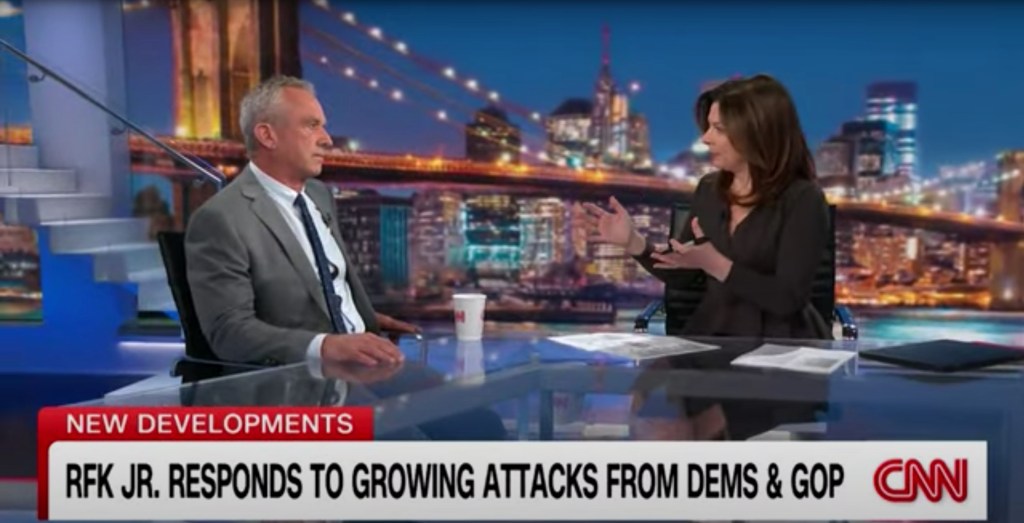
Today I was surprised to see an interview of presidential candidate RFK Jr. conducted by a CNN anchor and, despite all the awful ads embedded in the video, was glad to have watched. (While I realize this candidate has not focused on the women’s movement in corporate journalism, I think the only platformed person before him who’d even obliquely referenced the forces underlying the cooptation of the women’s movement in corporate journalism was Ricky Gervais; and his willingness to address the merger of corporate and government power on CNN of all outlets was interesting.) It’s interviews like this one that could be called attempts by large media corporations to refuel with at least some measure of legitimacy that could be just the chance the country needs to name what they are doing, change drivers, and focus on where we all want to go as we have so many shared goals.
This candidate has been widely critiqued for seeking the presidency as a means, among other things, to overcome the problem of censorship. The women’s movement in corporate journalism has been similarly lampooned for talking about problems arguably far too common in environments characterized by concentrations of power so extreme they may be considered not only incompatible with human nature but with democracy itself. But the outcomes of such decisions remain to be seen and perhaps all any one of us can do is take responsibility for the condition of our own heart as a means of letting the chips fall where they ought. And I, increasingly, believe this to be a good thing in pursuit of a future where even those who are not rich can make valuable contributions.
 Recent Writing